


Living in the Tropics? Your Coffee Is Going Stale Faster Than You Think
Most of the coffee storage advice you’ll find online was written by people living in London, Melbourne, or Portland. Places with average temperatures of 15–20°C. Places where humidity sits around 50–60%.
That advice — keep your coffee in a cool, dry place — is correct. It just wasn’t written with Penang in mind.
At 30°C and 80% relative humidity, your kitchen is not a cool, dry place. And the gap between how coffee behaves in a temperate climate versus a tropical one is larger than most guides will tell you.
This is the coffee storage chapter that was written specifically for where you live.
Why Heat Is Coffee’s Biggest Enemy
Coffee staling is a chemical process. Like most chemical processes, it speeds up with heat.
The primary culprits are oxidation (oxygen reacting with coffee’s aromatic compounds) and hydrolysis (moisture breaking down certain flavour-bearing molecules). Both reactions happen at room temperature. Both happen significantly faster as temperature rises.
A rough guide: for every 10°C increase in temperature, the rate of chemical degradation in food approximately doubles. This is sometimes called the Q10 rule, and while it’s a generalisation, it holds well enough to be useful.
What this means practically: coffee stored at 30°C (a typical Malaysian kitchen) is degrading roughly twice as fast as coffee stored at 20°C (a typical kitchen in Germany or the UK). Coffee stored at 35°C — near a stove, on top of the refrigerator, or near a window with afternoon sun — is degrading four times as fast.
That bag of beans you bought a week ago? In Malaysia, it’s effectively two weeks old by temperate-country standards.
And Then There’s Humidity
Humidity compounds the problem in two ways.
First, moisture accelerates oxidation. Water molecules act as a medium through which oxygen interacts more easily with coffee’s volatile aromatic compounds. High humidity essentially speeds up the very process you’re trying to slow down.
Second, moisture degrades the packaging. Coffee bags are designed to keep moisture out, but paper-laminate bags — which are common in specialty coffee packaging — are more permeable to moisture vapour than full foil or multilayer film bags. In a humid environment, moisture can slowly migrate through the bag material itself, even if the seal is intact.
This is why you’ll sometimes notice that coffee stored in Malaysia during the wet season loses its aroma more quickly than the same coffee stored in a drier month. It’s not your imagination.
The Four Enemies in Your Kitchen
Understanding where the threats are makes it easier to avoid them. In a typical Malaysian home or café, coffee faces four main enemies:
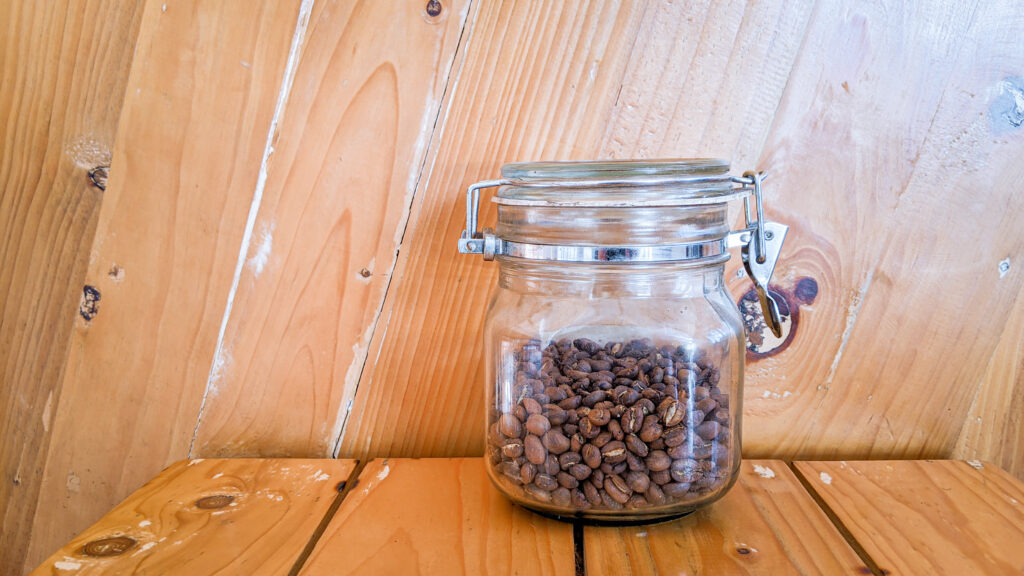
1. Direct sunlight UV light degrades organic compounds rapidly. A glass jar of coffee on a sunny counter can lose noticeable aroma within days. Never store coffee in a clear container near a window. If your kitchen gets afternoon sun, this matters even more.
2. Heat from appliances The top of the refrigerator is warm — the compressor radiates heat constantly. Shelves near the stove or kettle experience temperature spikes every time they’re used. These are common storage spots and almost universally bad for coffee.
3. Ambient humidity Open containers, loosely sealed bags, and zip locks that aren’t pressed flat all allow humid air in. In Malaysia’s climate, even a few hours of exposure each day adds up over a week.
4. Temperature fluctuations Moving coffee from a cool air-conditioned room to a warm kitchen repeatedly causes condensation inside the bag — microscopic water droplets forming on the beans themselves. This is a particular risk if you store your coffee in the fridge (more on this below).
Should You Refrigerate Your Coffee?
This question comes up constantly, and the answer in a tropical context is more nuanced than the standard “never refrigerate coffee” advice.
The standard advice comes from temperate climates where ambient temperatures are already cool enough to slow degradation. The concern with refrigeration is primarily condensation — taking cold coffee out of the fridge into a warm room causes moisture to form on the beans — and odour absorption, as coffee readily absorbs smells from surrounding food.
In Malaysia, however, the calculus is different. At 30°C with 80% humidity, storing coffee on the counter is genuinely bad for freshness. Refrigeration, done correctly, can extend freshness significantly.
The rules for refrigerating coffee in a tropical climate:
- Only refrigerate whole beans, never ground coffee (ground coffee absorbs fridge odours far more readily)
- Use a vacuum-sealed container or at minimum a heavy zip-lock bag with all air squeezed out
- Store in a dedicated container away from strong-smelling foods
- Do not take the container in and out repeatedly. Instead, portion your beans into smaller containers — enough for 3–4 days — and only open one at a time. Leave the rest sealed in the fridge
- When you remove beans to grind, let the container sit at room temperature with the lid closed for 15–20 minutes before opening. This allows the container to warm slightly and prevents condensation forming on the beans when you open it
Done properly, refrigeration in a Malaysian climate can meaningfully extend the flavour window of your coffee — particularly for lighter roasts, which are more delicate and stale faster.
What About the Freezer?
Freezing coffee is a more serious intervention and one that specialty coffee professionals actually do use — for long-term storage of rare or expensive lots.
For everyday home use in Malaysia, the freezer is generally unnecessary if you’re buying coffee regularly and consuming it within 3–4 weeks. But if you’ve bought a large quantity of excellent coffee, want to preserve it for longer, or received a special lot as a gift, freezing can work well under the right conditions.
Rules for freezing coffee:
- Portion into small, airtight bags or containers — enough for one week’s use each
- Freeze immediately after portioning, before much off-gassing has occurred (ideally within the first few days post-roast)
- Once a portion is removed from the freezer, do not refreeze it — use it within a week
- As with the fridge: let the sealed container come to room temperature before opening, to prevent condensation on the beans
The biggest mistake with frozen coffee is treating the freezer like a magic freshness pause button you can press and release repeatedly. Freeze once. Thaw once. Then treat it like fresh coffee.
Practical Storage Guide for Malaysia
Here’s a straightforward set of recommendations based on your situation:
| Situation | Recommended storage |
|---|---|
| Buying 250g, consuming within 2 weeks | Original bag, sealed, in a cool cupboard away from appliances |
| Buying 500g+, consuming over 3–4 weeks | Portion into smaller airtight containers; refrigerate all but the current one |
| Buying 1kg+ or a large special lot | Portion and freeze; thaw one week’s portion at a time |
| Running a café | Weekly roast orders rather than monthly; store in a cool, dark area away from kitchen heat |
| Ground coffee | Use within 5–7 days; airtight container; never freeze or refrigerate |
A Note on Your Coffee Bag’s Lifespan in Malaysia
Coffee packaging is tested and rated for freshness under standard conditions — typically 20–25°C and moderate humidity. When you store that same bag at 30°C+ with 80% humidity, you’re effectively running outside the bag’s designed operating range.
This doesn’t mean the packaging fails. The degassing valve still works. The heat seal still holds. But the flavour window shortens.
Not sure what roast date you should be looking for when you buy? Read Chapter 4: Roast Date vs Expiry Date — Are You Reading the Right One? →
A practical adjustment: in Malaysia, treat the freshness timeline as 25–30% shorter than standard guidance. If a temperate-country guide says coffee is at its best within 30 days of roasting, aim to finish it within 20–22 days in our climate. If it says ground coffee lasts 2 weeks, plan to finish yours in 10 days.
The Bigger Picture
None of this means you can’t drink excellent coffee in Malaysia. It just means the climate is one more variable to manage — like dialling in your grinder, or calibrating your water temperature.
The roasters, cafés, and home brewers who produce the best coffee in Penang, KL, and across Malaysia are working with this reality every day. They order more frequently, store more carefully, and use their coffee faster. The result is coffee that tastes as good here as it would anywhere else in the world.
That’s the goal. And now you have the information to get there.
This post is part of our series “The Secrets Inside Your Coffee Bag”:
- Chapter 1: That Little Circle on Your Coffee Bag Is Not a Sniff Hole →
- Chapter 2: Should You Seal the Valve? Whole Beans vs Ground Coffee →
- Chapter 3: What Happens to Your Coffee Bag on a Plane? →
- Chapter 4: Roast Date vs Expiry Date — Are You Reading the Right One? →
- Chapter 5: Living in the Tropics? Your Coffee Is Going Stale Faster Than You Think ← You are here