


What Happens to Your Coffee Bag on a Plane?
You’ve just landed in Kyoto, or Chiang Mai, or a small town in Ethiopia. You found an incredible local roaster. You bought two bags. You’re bringing them home.
You check them into your luggage, board the flight, and somewhere over the South China Sea — something happens. By the time you land and unzip your bag, one of the coffee bags looks strangely puffy. The other has a small oily patch on the outside. You press the top seal and it feels tight, tense, like it’s holding something back.
Nothing is wrong with your coffee. But something very interesting happened at 35,000 feet.
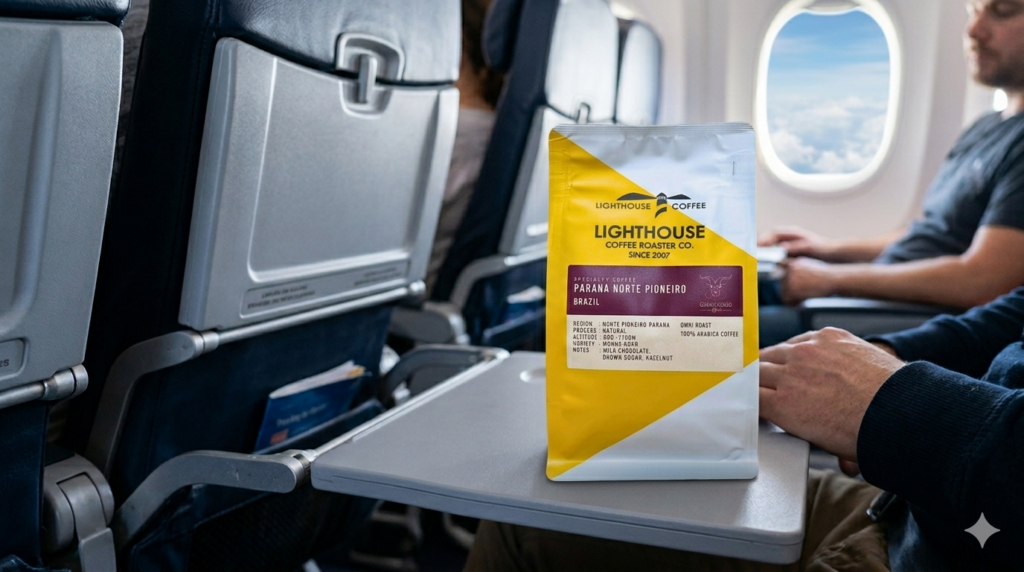
Air Pressure at Cruising Altitude
Commercial aircraft cruise at around 30,000 to 38,000 feet. At that altitude, the outside air pressure is about 75% lower than at sea level — far too low for human comfort. So aircraft cabins are pressurised, but typically only to the equivalent of around 1,800 to 2,400 metres above sea level (roughly the pressure you’d experience on a high mountain).
That’s still noticeably lower than sea level pressure. And lower cabin pressure has a direct effect on anything sealed with gas inside it.
Why Your Coffee Bag Puffs Up
Freshly roasted coffee is constantly releasing CO₂ — the natural by-product of the roasting process. Under normal conditions, the one-way degassing valve handles this steadily: a little pressure builds, the valve opens, CO₂ escapes, the valve closes.
On a plane, the lower cabin pressure changes the equation.
Think of it like a sealed bag of crisps — you’ve almost certainly noticed how puffy those get mid-flight. The same principle applies to your coffee. The gas inside the bag, which was in equilibrium at ground-level pressure, now occupies a relatively larger volume at reduced cabin pressure. The bag expands.
For freshly roasted beans (within the first week after roasting), there’s enough active off-gassing that the combined effect of CO₂ release plus reduced cabin pressure can make the bag inflate quite noticeably. The degassing valve will work to equalise, but if the gas is releasing faster than the valve can handle, you’ll feel the bag tighten.
For older beans (two or more weeks post-roast), most of the CO₂ has already been released at ground level. These bags are less likely to puff dramatically, because there’s simply less gas left to expand.
The Oily Patch Problem
Some bags — particularly those without a well-fitted degassing valve, or with a valve disc that’s been worn or damaged — can develop a small oily patch on the outside of the bag during a flight. This is coffee oil seeping through a stressed seal or a compromised valve.
Coffee beans are naturally oily, especially darker roasts. When pressure inside the bag spikes and the valve is not functioning perfectly, microscopic amounts of coffee oil can be pushed through the valve body or a weakened seam. You’ll often see this as a small, slightly translucent stain on the outside of the bag.
It doesn’t mean the coffee is bad. But it is a sign that the packaging was under stress — and that a tiny amount of oxygen may have found its way in during the pressure fluctuations.
Checked Luggage vs Carry-On
There’s a common question among coffee travellers: is it better to pack coffee in checked luggage or carry-on?
Checked luggage goes into the cargo hold, which is pressurised to roughly the same level as the cabin — so the pressure difference is similar. However, cargo holds are not temperature-controlled on all aircraft, meaning your coffee may be exposed to temperature extremes depending on the route, especially on long-haul flights. Cold temperatures slow down off-gassing but can briefly affect bean structure. Heat accelerates oxidation.
Carry-on keeps your coffee at cabin temperature, which is more consistent. The trade-off is physical pressure from other items in an overhead bin — overpacking a bag with a coffee package underneath heavy items can stress the valve or seams.
Practical recommendation: carry coffee in your carry-on if possible, placed on top of other items. If it must go in checked luggage, wrap it in a layer of clothing for insulation and protection from impact.
What to Do Before You Fly
If you’re buying specialty coffee to bring home — whether as a gift or for yourself — a few simple steps can help it survive the journey in better condition.
Choose whole beans over ground. Whole beans are more stable, degas more slowly, and have less exposed surface area to oxidise. Ground coffee in a bag can go flat faster under travel stress.
Check the roast date. This is one of the most underrated travel tips for coffee lovers. If the bag was roasted within the last 3 days, it is still off-gassing very actively — the flight will put the packaging under more stress. If possible, choose a bag roasted 5–10 days ago: fresh enough to taste great, but past the most intense CO₂ release phase.
Don’t know how to read the roast date? Read Chapter 4: Roast Date vs Expiry Date — Are You Reading the Right One? →
Check the valve. Before buying, gently press around the valve area. It should feel like a small raised disc that moves slightly under pressure. If it feels hard and completely immovable, or if there’s already an oily mark around it, choose a different bag.
Don’t over-squeeze the bag. Packing coffee tightly against hard objects or compressing it to “save space” puts mechanical stress on the valve and seams — which are already going to be under pressure from the altitude change.
When You Land
If your coffee bag arrived puffed up, that’s normal — and not a reason to worry. Once you’re back at ground-level pressure, the bag will gradually return to its normal shape as the pressure equalises and CO₂ continues to slowly escape through the valve.
Give it a few hours. Don’t forcibly flatten it or squeeze the air out through the top seal. Just let it sit, and the valve will do its job.
If the bag arrived with a broken seal or a significant oil stain, transfer the beans to an airtight container as soon as possible and use them within a week or two. The flavour will still be good — it just may not stay that way for long.
The Bigger Picture
Your coffee survived a flight, temperature changes, pressure shifts, and a long journey from the farm to your cup. A slightly puffy bag doesn’t undo any of that. It just means the packaging was working exactly as it should.
The one-way degassing valve that caused so much confusion in Chapter 1 was doing its job at altitude too — releasing pressure, protecting the seal, keeping oxygen out. The engineering is the same at 35,000 feet. It’s just a little more dramatic up there.
This post is part of our series “The Secrets Inside Your Coffee Bag”:
- Chapter 1: That Little Circle on Your Coffee Bag Is Not a Sniff Hole →
- Chapter 2: Should You Seal the Valve? Whole Beans vs Ground Coffee →
- Chapter 3: What Happens to Your Coffee Bag on a Plane? ← You are here
- Chapter 4: Roast Date vs Expiry Date — Are You Reading the Right One? →
- Chapter 5: Living in the Tropics? Your Coffee Is Going Stale Faster Than You Think →